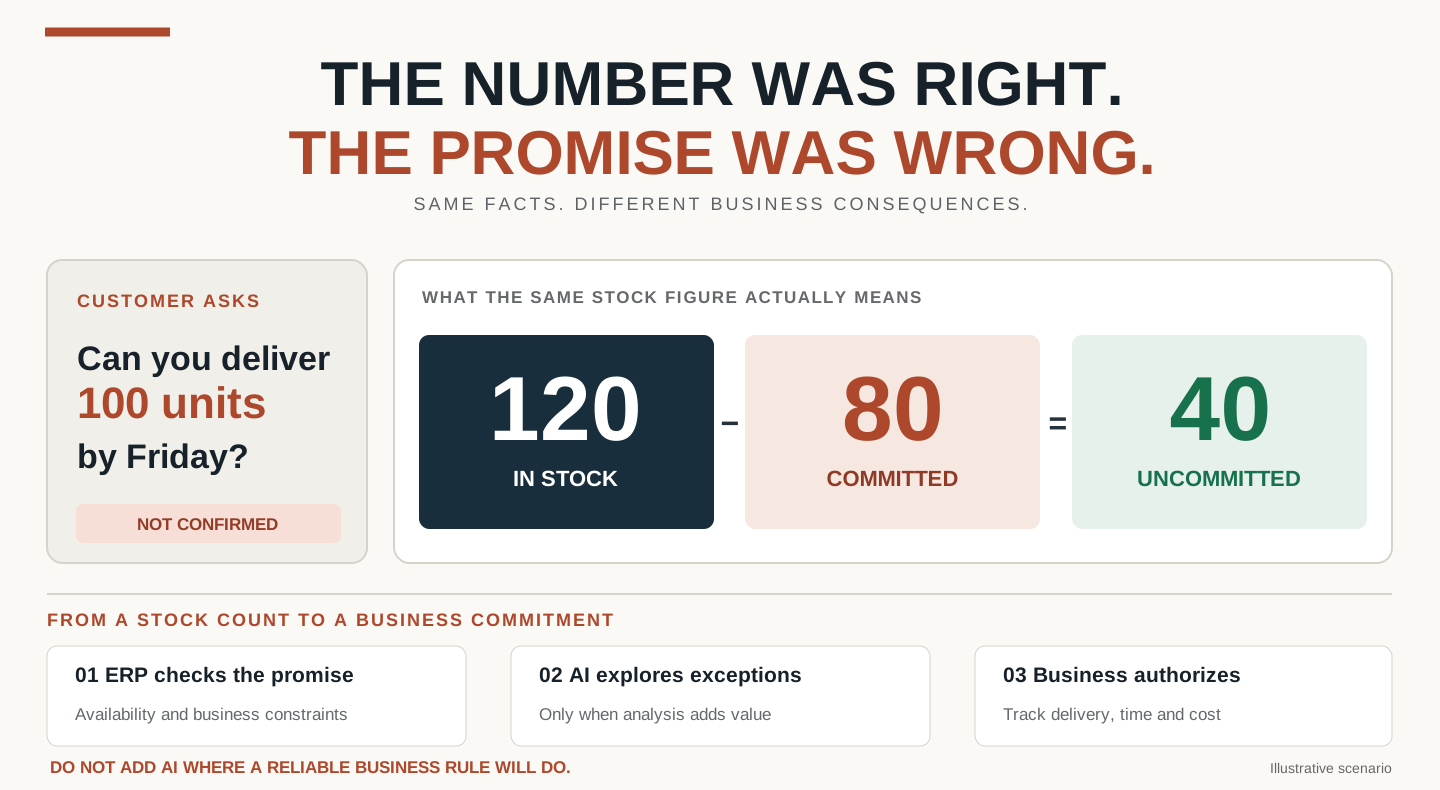
A customer asks: “Can you deliver 100 units by Friday?”
The inventory system shows 120 units in stock. An AI assistant retrieves that number and confidently responds, “Yes.”
But 80 units are already committed to existing customers. Only 40 remain uncommitted. Even those 40 may not be deliverable by Friday without further checks.
No fabricated data was necessary. The failure was the difference between answering an information question and making a business commitment.
Illustrative scenario only. No production implementation or measured customer benefit is implied.
The first question is not which AI to use
Why did the system make an incorrect promise? Was the inventory information incomplete? Were commitments ignored? Was an availability check bypassed? Was the business process allowed to confirm an order without validation?
These are different problems requiring different solutions.
Enterprise systems already offer capabilities such as available-to-promise (ATP) to evaluate whether quantities and delivery dates can be confirmed, subject to the configured data and business constraints.
If the problem is an incorrect availability check or disconnected process, correct that first.
Adding AI to a broken business process can make the wrong answer arrive faster.
Where Enterprise AI can make a difference
Now change the question: “We cannot confirm 100 units by Friday. What are our best feasible alternatives?”
The answer could involve inventory in other locations, replenishment plans, production capacity, shipment options, customer priorities, contract terms and additional cost.
Some alternatives can be handled by business rules or optimization engines. Others may benefit from AI that compares complex scenarios, explains trade-offs and recommends options across systems and business boundaries.
For example, it might evaluate a partial delivery, an alternative fulfilment location or expedited replenishment.
AI should not invent the commitment. The relevant enterprise systems must validate the option, and an authorized business process must permit the action.
The architecture choice comes before the technology choice
Before recommending AI, I would evaluate three interventions.
Check inventory, allocations, order-promising rules and process integration.
Apply workflows, deterministic rules and optimization where sufficient.
Compare complex exceptions when the incremental value justifies cost and risk.
This is a decision sequence, not a universal deployment recipe. Priorities must reflect the scale of the problem, business benefit, implementation feasibility, cost and risk.
Enterprise Architecture makes the decision defensible
This is not simply about model quality. The enterprise must connect the business capability being improved to the information it trusts, the systems that enforce business rules, the authority to make commitments and the outcomes it expects.
Business Architecture defines the capability and its value. Data Architecture establishes authoritative information and context. Application Architecture defines roles for ERP, order management, workflows and AI services. Technology Architecture supports security, integration, reliability and observability.
Business owners remain accountable for decisions. Domain, solution, data, security and operations teams establish and operate the necessary controls.
Not every AI use case needs an agent, retrieval system or knowledge graph. The implementation should follow the decision, not the other way around.
Measure business improvement, not AI activity
Suppose AI-assisted exception handling is introduced. Model accuracy, prompt counts or response speed do not prove success.
Start with a baseline. Compare the result with the existing process and with simpler alternatives. Measure:
- Time taken to provide a feasible and authorized customer commitment.
- On-time delivery against confirmed promises.
- Incorrect or unauthorized delivery commitments.
- Cost and cycle time of resolving fulfilment exceptions.
If AI does not produce sufficient incremental business value for the cost and risk involved, there is no compelling reason to deploy it.
The point
The same distinction appears in other industries. Identifying someone as eligible for credit does not authorize a loan. Suggesting a supplier does not make that supplier approved. Access to clinical information does not itself authorize disclosure or clinical action.
Across industries, an intelligent output is only part of a decision. The enterprise must know what is reliable, what is permitted, who is accountable and what actually improved.
Enterprise AI is the controlled application of intelligence to enterprise capabilities, using authoritative business information, explicit decision rights and measurable outcomes.
The question worth asking is not “What can we do with AI?” It is “Which business decisions or activities can intelligence improve, and what evidence justifies using it?”
Sometimes the answer is AI. Sometimes it is an optimization engine, a business rule or a corrected process.
Enterprise AI is not about making more decisions with AI. It is about helping the enterprise make better decisions, with clear accountability.
References and scope
- SAP Advanced Available-to-Promise for the established role of availability services.
- NIST AI Risk Management Framework for AI governance, context, risk and measurement.
- ISO/IEC 42001:2023 for organizational AI management system requirements.
Independent architectural interpretation. The example is hypothetical and does not claim validated AI results or a client deployment.